


ISSUE1757


- Jean-Marie Pflomm, Pharm.D., Editor in Chief has disclosed no relevant financial relationships.
- Corinne Z. Morrison, Pharm.D., Associate Editor has disclosed no relevant financial relationships.
- Review the efficacy and safety of tradipitant (Nereus) for prevention of motion sickness.
- Description: An oral substance P/neurokinin-1 (NK-1) receptor antagonist
- Indication: Prevention of vomiting induced by motion in adults
- Efficacy: In 2 placebo-controlled trials, tradipitant significantly reduced motion-induced vomiting.
- Adverse Effects: Most common were somnolence, headache, and fatigue
- Drug Interactions: Strong inhibitors of CYP3A4 can increase tradipitant serum concentrations.
- Dosage: 85 or 170 mg about one hour before an event expected to cause vomiting induced by motion; only one dose per 24-hour period is recommended.
- Cost: One 85-mg capsule costs $255.
- Conclusion: Tradipitant can prevent motion-induced vomiting. How it compares to transdermal scopolamine (Transderm Scop, and generics) or to inexpensive over-the-counter antihistamines remains to be determined.
The FDA has approved the oral substance P/neurokinin-1 (NK-1) receptor antagonist tradipitant (Nereus – Vanda) for prevention of vomiting induced by motion in adults. Tradipitant is the first drug to be approved for motion sickness in more than 40 years. Other oral substance P/NK-1 receptor antagonists (i.e., aprepitant, rolapitant, and netupitant) have been available for years for prevention of chemotherapy-induced nausea and vomiting.1-3

STANDARD TREATMENT — Pharmacologic options for prevention of motion sickness are limited. Over-the-counter first-generation antihistamines such as dimenhydrinate (Dramamine, and others) and meclizine (Bonine, and others) are effective, but they cause sedation.4 A transdermal formulation of the anticholinergic drug scopolamine (Transderm Scop, and generics) placed behind the ear can prevent symptoms of motion sickness; it can cause sedation, dry mouth and other anticholinergic adverse effects, and hyperthermia.5,6 Promethazine has been used when over-the-counter antihistamines and scopolamine are ineffective, but data on its effectiveness are limited and it causes sedation.
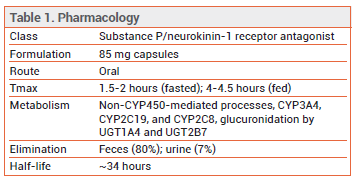
MECHANISM OF ACTION — The binding of substance P to NK-1 receptors plays a role in the transmission of stress and pain signals, contraction of smooth muscles, and emesis. Tradipitant selectively inhibits substance P/NK-1 receptors in the central nervous system, GI tract, and other peripheral tissues.
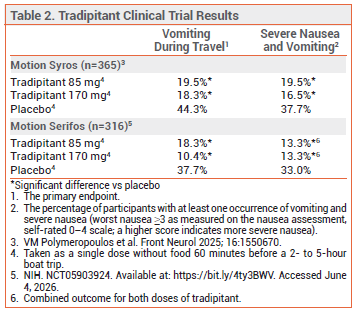
CLINICAL STUDIES — FDA approval of tradipitant was based on the results of two double-blind trials (Motion Syros and Motion Serifos) in a total of 681 adults with a history of motion sickness who were randomized to receive a single dose of tradipitant 85 mg, tradipitant 170 mg, or placebo 60 minutes before taking a 2- to 5-hour boat trip. In both trials, participants who took tradipitant were significantly less likely than those who took placebo to experience vomiting during the trip, the primary endpoint (see Table 2).7,8
ADVERSE EFFECTS — The most common adverse effects (incidence ≥5% and more often than with placebo) of tradipitant in the pivotal trials were somnolence, headache, and fatigue.
DRUG INTERACTIONS — Tradipitant is a substrate of CYP3A4; concurrent use of strong CYP3A4 inhibitors can increase tradipitant serum concentrations.9
PREGNANCY AND LACTATION — No adequate data are available on tradipitant use in pregnant or lactating women. No adverse developmental effects were observed in animal studies. Tradipitant is present in animal milk; breastfed infants should be monitored for somnolence.
DOSAGE, ADMINISTRATION, AND COST — The recommended dosage of tradipitant is 85 mg or 170 mg taken once about one hour before an event expected to cause motion-induced vomiting; only one dose per 24-hour period is recommended. The drug should be taken on an empty stomach (one hour before or two hours after a meal). The wholesale acquisition cost for one 85-mg capsule of Nereus is $255.10
CONCLUSION — Tradipitant (Nereus) is effective in preventing motion-induced vomiting. How it compares to transdermal scopolamine (Transderm Scop, and generics) or to inexpensive over-the-counter antihistamines such as dimenhydrinate (Dramamine, and others) and meclizine (Bonine, and others) remains to be determined.
View the Comparison Chart: Drugs for Motion Sickness
- Aprepitant (Emend) for prevention of nausea and vomiting due to cancer chemotherapy. Med Lett Drugs Ther 2003; 45:62.
- Rolapitant (Varubi) for prevention of delayed chemotherapyinduced nausea and vomiting. Med Lett Drugs Ther 2016; 58:17.
- Netupitant/palonosetron (Akynzeo) for chemotherapy-induced nausea and vomiting. Med Lett Drugs Ther 2015; 57:61.
- A Koch et al. The neurophysiology and treatment of motion sickness. Dtsch Arztebl Int 2018; 115:687. doi:10.3238/arztebl.2018.0687
- A Spinks and J Wasiak. Scopolamine (hyoscine) for preventing and treating motion sickness. Cochrane Database Syst Rev 2011; 6:CD002851. doi:10.1002/14651858.cd002851.pub4
- In brief: Hyperthermia with scopolamine patches. Med Lett Drugs Ther 2025; 67:136.
- VM Polymeropoulos et al. Motion Syros: tradipitant effective in the treatment of motion sickness; a multicenter, randomized, double-blind, placebo-controlled study. Front Neurol 2025; 16:1550670. doi:10.3389/fneur.2025.1550670
- NIH. Motion Serifos: a study to investigate the efficacy of tradipitant in participants affected by motion sickness. NCT05903924. Available at: https://bit.ly/4ty3BWV. Accessed June 4, 2026.
- Inhibitors and inducers of CYP enzymes, P-glycoprotein, and other transporters. Med Lett Drugs Ther 2023 January 25 (epub). Available at: www.medicalletter.org/downloads/CYP_PGP_Tables.pdf.
- Approximate WAC. WAC = wholesaler acquisition cost or manufacturer's published price to wholesalers; WAC represents a published catalogue or list price and may not represent an actual transactional price. Source: AnalySource® Monthly. May 5, 2026. Reprinted with permission by First Databank, Inc. All rights reserved. ©2026. www.fdbhealth.com/drug-pricing-policy.
The Medical Letter, Inc. does not warrant that all the material in this publication is accurate and complete in every respect. The Medical Letter, Inc. and its editors shall not be held responsible for any damage resulting from any error, inaccuracy, or omission.

 Previous article