


ISSUE1767


- Jean-Marie Pflomm, Pharm.D., Editor in Chief has disclosed no relevant financial relationships.
- Brinda M. Shah, Pharm.D., Consulting Editor has disclosed no relevant financial relationships.
- Review the efficacy and safety of tavapadon (Juvmo) for treatment of Parkinson's disease.
- Description: An oral nonergot partial dopamine agonist
- Indication: Treatment of Parkinson’s disease (PD) in adults
- Efficacy: In patients with early PD, tavapadon improved physical and motor symptoms compared to placebo. In patients who had motor fluctuations despite levodopa treatment, addition of tavapadon increased on time without troublesome dyskinesia and decreased daily off time compared to placebo.
- Adverse Effects: Most common were nausea, dyskinesia, dizziness, headache, hallucinations, and orthostatic hypotension.
- Drug Interactions: Use of strong or moderate CYP3A inhibitors during dosage titration and use of strong CYP3A inducers during dosage titration and maintenance should be avoided. Adjustments in the maintenance dosage are required when taken with strong or moderate CYP3A inhibitors or moderate inducers.
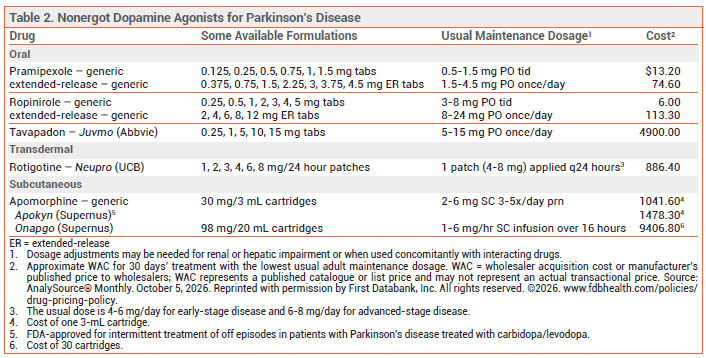
- Dosage: Titrated over 40 days to a maintenance dosage of 5 mg once daily (max 15 mg/day).
- Cost: A 30-day supply costs $4900.
- Conclusion: How tavapadon compares to other dopamine agonists used for treatment of PD remains to be established.
Tavapadon (Juvmo – Abbvie), an oral nonergot partial dopamine agonist, has been approved by the FDA for treatment of Parkinson's disease (PD).

STANDARD TREATMENT — The combination of levodopa and carbidopa is the most effective treatment for the motor symptoms of PD.1 For the first 2-5 years of treatment, it produces a consistent response, but as the disease progresses, the duration of benefit from each dose becomes shorter (wearing-off effect) and patients experience fluctuations between mobility and immobility (on-off effect). After 5-8 years, most patients experience worsening of motor fluctuations and dyskinesia.
Nonergot dopamine agonists (see Table 2) are less likely to cause motor fluctuations and dyskinesia than carbidopa/levodopa. They are effective as monotherapy in early, mild PD, but most patients require addition of carbidopa/levodopa within a few years. Used as adjuncts in advanced disease, dopamine agonists can reduce motor fluctuations and permit use of lower doses of levodopa.2 They can cause lower-extremity edema, nausea, vomiting, orthostatic hypotension, impulse control behaviors, and, particularly in elderly patients, confusion, hallucinations, and psychosis. Older ergot-derivative dopamine agonists, such as bromocriptine, can cause serious adverse effects and are no longer recommended for treatment of PD.
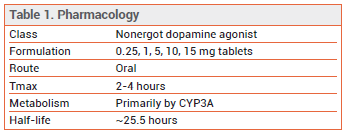
MECHANISM OF ACTION — Unlike currently available dopamine agonists, which primarily target dopamine D2 and D3 receptors, tavapadon is a partial agonist at dopamine D1 and D5 receptors. Selectively targeting D1 and D5 receptors has been hypothesized to reduce the likelihood of somnolence, impulse control behaviors, and hallucinations that occur with other dopamine agonists.
CLINICAL STUDIES — FDA approval of tavapadon was based on the results of 3 double-blind trials (TEMPO-1, -2, and -3) in a total of 1340 patients with PD.
Treatment-Naive – TEMPO-1 and -2 included patients with early PD who were treatment-naive or had previously received <3 months of dopaminergic therapy. In TEMPO-1, 529 patients were randomized to receive tavapadon 5 mg or 15 mg or placebo once daily. At week 26, the mean change from baseline in the Movement Disorder Society-Unified Parkinson's Disease Rating Scale (MDS-UPDRS) parts II and III score (part II measures 13 motor-related activities of daily living on a scale of 0-4, with higher scores indicating greater disability; part III measures 33 physical signs of PD such as speech, facial expression, and rigidity on a scale of 0-4, with higher scores indicating greater impairment) was significantly greater with both doses of tavapadon than with placebo (-9.7 with the 5-mg dose and -10.2 with the 15-mg dose vs +1.8 with placebo).3
In TEMPO-2, 304 patients were randomized to receive tavapadon 5-15 mg or placebo once daily. At week 26, the mean change from baseline in the MDS-UPDRS parts II and III score was significantly greater with tavapadon than with placebo (-10.3 vs -1.2).4
Treatment-Experienced – In TEMPO-3, 507 patients who had motor fluctuations despite treatment with oral levodopa were randomized to addition of tavapadon 5-15 mg or placebo once daily for 27 weeks. Tavapadon significantly increased daily on time without troublesome dyskinesia (1.70 vs 0.60 hours with placebo) and significantly decreased daily off time (1.88 vs 0.93 hours with placebo).5
Head-to-head trials comparing tavapadon with other dopamine agonists are lacking.
ADVERSE EFFECTS — The most common adverse effects of tavapadon in the TEMPO trials were nausea, dyskinesia, dizziness, headache, hallucinations, and orthostatic hypotension. Like other dopaminergic agonists, psychosis and impulse control behaviors, including gambling, hypersexuality, obsessive viewing of pornography, uncontrollable spending, and excessive computer use, have been reported with tavapadon.
DRUG INTERACTIONS — Tavapadon is a CYP3A substrate, an inducer of CYP3A, and an inhibitor of CYP2C8 and breast cancer resistance protein (BCRP). Coadministration of strong or moderate CYP3A inhibitors during dosage titration and strong CYP3A inducers during dosage titration and maintenance should be avoided. Adjustments in the maintenance dosage of tavapadon are required when tavapadon is used with strong or moderate CYP3A inhibitors or moderate CYP3A inducers.6 Reductions in the dosage of CYP2C8 or BCRP substrates may be needed when they are taken with tavapadon.
Dopamine antagonists may reduce the effectiveness of tavapadon. Use with other dopaminergic drugs, including levodopa, may increase the risk of dyskinesia and other dopaminergic adverse effects. Use of tavapadon with other drugs that lower blood pressure can cause orthostatic hypotension.
DOSAGE AND ADMINISTRATION — Tavapadon can be used alone or in combination with levodopa. The recommended starting dosage is 0.25 mg once daily for 4 days; the dosage should be titrated to 3 mg once daily over 40 days (0.5 mg on days 5-8, 0.75 mg on days 9-12, 1 mg on days 13-16, 1.5 mg on days 17-20, 2.25 mg on days 21-24, 3 mg on days 25-40) and then to a maintenance dosage of 5 mg once daily. If needed, the dosage can be further increased in 5-mg increments over ~15 days to a maximum of 15 mg once daily.
CONCLUSION — The oral nonergot partial dopamine D1 and D5 receptor agonist tavapadon (Juvmo) improved motor symptoms in adults with early Parkinson's disease (PD) and increased on time without troublesome dyskinesia in patients with PD experiencing motor fluctuations despite treatment with levodopa. How tavapadon compares to other dopamine agonists used for treatment of PD remains to be determined.
- Drugs for Parkinson's disease. Med Lett Drugs Ther 2021; 63:25.
- W Sako et al. Comparative efficacy and safety of adjunctive drugs to levodopa for fluctuating Parkinson's disease – network meta-analysis. NPJ Parkinsons Dis 2023; 9:143. doi:10.1038/s41531-023-00589-8
- R Pahwa et al. Fixed-dose tavapadon for early Parkinson disease: a randomized clinical trial. JAMA Neurol 2026; 83:452. doi:10.1001/jamaneurol.2026.0590
- HH Fernandez et al. Safety, tolerability, and efficacy of flexibl-edose tavapadon for Parkinson’s disease (TEMPO-2): a phase 3, randomised, placebo-controlled, double-blind trial. Lancet Neurol 2026; 25:721. doi:10.1016/s1474-4422(26)00215-2
- HH Fernandez et al. Tavapadon as adjunctive treatment for Parkinson disease: the TEMPO-3 randomized clinical trial. JAMA Neurol 2026; 83:442. doi:10.1001/jamaneurol.2026.0577
- Inhibitors and inducers of CYP enzymes, P-glycoprotein, and other transporters. Med Lett Drugs Ther 2023 January 25 (epub). Available at: www.medicalletter.org/downloads/CYP_PGP_Tables.pdf.
The Medical Letter, Inc. does not warrant that all the material in this publication is accurate and complete in every respect. The Medical Letter, Inc. and its editors shall not be held responsible for any damage resulting from any error, inaccuracy, or omission.

 Previous article
