


ISSUE1766


- Jean-Marie Pflomm, Pharm.D., Editor in Chief has disclosed no relevant financial relationships.
- Amy Faucard, MLS, Associate Editor has disclosed no relevant financial relationships.
- Review the efficacy and safety of tezepelumab (Tezspire) for add-on maintenance treatment of inadequately controlled chronic rhinosinusitis with nasal polyps.
- Description: A subcutaneously administered thymic stromal lymphopoietin (TSLP) blocker
- Indication: Add-on maintenance treatment of inadequately controlled chronic rhinosinusitis with nasal polyps (CRSwNP) in patients ≥12 years old
- Efficacy: In a double-blind 52-week trial in adults with severe uncontrolled CRSwNP receiving intranasal corticosteroids, addition of tezepelumab significantly reduced nasal polyp size, nasal congestion, and the need for nasal polyp surgery compared to placebo.
- Adverse Effects: Most common were nasopharyngitis, upper respiratory tract infection, epistaxis, pharyngitis, back pain, influenza, injection-site reactions, and arthralgia
- Drug Interactions: Administration of live-attenuated vaccines should be avoided during treatment.
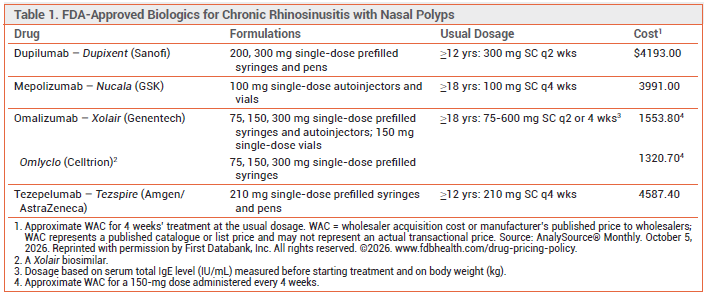
- Dosage: 210 mg SC q4 weeks
- Cost: A 4-week supply (one dose) costs about $4587.
- Conclusion: Add-on treatment with tezepelumab can improve sinonasal symptoms and reduce polyp burden in patients with CRSwNP. How it compares to other biologics approved for this indication remains to be determined.
The FDA has approved tezepelumab (Tezspire – Amgen/AstraZeneca), a subcutaneously administered thymic stromal lymphopoietin (TSLP) blocker, for add-on maintenance treatment of inadequately controlled chronic rhinosinusitis with nasal polyps (CRSwNP) in patients ≥12 years old. It is the first TSLP blocker to be approved for this indication. Tezepelumab was approved for add-on maintenance treatment of severe asthma in 2021.1
STANDARD TREATMENT — About 25% of patients with chronic rhinosinusitis develop nasal polyps. Symptoms include nasal discharge, congestion, and obstruction and anosmia. An intranasal corticosteroid can improve sinonasal symptoms and reduce polyp size and is recommended for initial treatment, sometimes in combination with nasal saline irrigation. A short course of an oral steroid can be used to reduce symptoms and polyp size in patients with obstruction or reduced sense of smell and significant polyp burden. The anti-IgE antibody omalizumab, the interleukin (IL)-4 receptor alpha antagonist dupilumab, and the IL-5 antagonist mepolizumab are FDA-approved for add-on treatment of CRSwNP that is inadequately controlled with intranasal corticosteroids (see Table 1).2,3
Nasal polyp surgery is an option for patients who have had an inadequate response to initial treatment.4 Polyps may recur following surgical removal.
MECHANISM OF ACTION — TSLP is an epithelial cell-derived cytokine that is an upstream activator of multiple inflammatory cascades. Elevated levels of TSLP have been found in nasal polyp tissue. Tezepelumab is a human monoclonal antibody that binds to TSLP, blocking it from interacting with its receptor.5
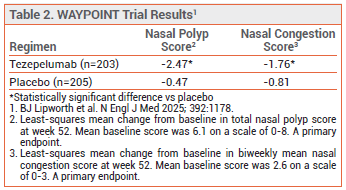
A CLINICAL STUDY — Approval of tezepelumab for the new indication was based on the results of a double-blind trial (WAYPOINT) in 408 patients ≥18 years old with severe uncontrolled CRSwNP despite treatment with intranasal corticosteroids; ~60% of patients had coexisting asthma and ~70% had previous nasal polyp surgery. Patients were randomized to addition of tezepelumab 210 mg SC or placebo every 4 weeks for 52 weeks. Treatment with tezepelumab significantly reduced the size of nasal polyps and the severity of nasal congestion and sinonasal symptoms compared to placebo at 1 year (see Table 2). Patients who received tezepelumab were also significantly less likely than those who received placebo to require nasal polyp surgery (0.5% vs 22.0%) or treatment with oral corticosteroids (5.2% vs 19.3%).6
ADVERSE EFFECTS — The most common adverse effects of tezepelumab in the WAYPOINT trial (incidence ≥3% and greater than with placebo) were nasopharyngitis, upper respiratory tract infection, epistaxis, pharyngitis, back pain, influenza, injection-site reactions, and arthralgia. TSLP may be involved in the immunological response to some parasitic infections; such infections should be treated before starting tezepelumab.
DRUG INTERACTIONS — Administration of live-attenuated vaccines during treatment with tezepelumab has not been evaluated and should be avoided.
PREGNANCY AND LACTATION — No data are available on the use of tezepelumab in pregnant or breastfeeding women. In a study in pregnant cynomolgus monkeys, IV administration of the drug was not associated with adverse fetal outcomes; tezepelumab was present in their milk postpartum.
DOSAGE AND ADMINISTRATION — Tezspire is supplied in single-dose prefilled syringes and pens containing 210 mg/1.91 mL of tezepelumab. The recommended dosage is 210 mg injected subcutaneously in the upper arm, abdomen, or thigh once every 4 weeks. Tezspire syringes should be administered by a healthcare provider; pens can be administered by the patient (except in the upper arm) or a caregiver.
CONCLUSION — In patients with chronic rhinosinusitis with nasal polyps (CRSwNP), add-on maintenance treatment with the thymic stromal lymphopoietin (TSLP) blocker tezepelumab (Tezspire) can reduce nasal polyp size, nasal congestion, and the need for nasal polyp surgery and oral corticosteroid therapy and appears to be generally well tolerated. Tezepelumab has not been directly compared with other biologics approved for this indication.
- Tezepelumab (Tezspire) for severe asthma. Med Lett Drugs Ther 2022; 64:25.
- MA Rank et al. The Joint Task Force on Practice Parameters GRADE guidelines for the medical management of chronic rhinosinusitis with nasal polyposis. J Allergy Clin Immunol 2023; 151:386. doi:10.1016/j.jaci.2022.10.026
- A Safia et al. Optimizing biologic treatment selection in chronic rhinosinusitis with nasal polyps: a network meta-analysis of efficacy and safety across 22 RCTs. Pharmaceuticals (Basel) 2025; 18:1455. doi:10.3390/ph18101455
- JC Simmonds et al. Endoscopic sinus surgery for chronic rhinosinusitis: 22-item sino-nasal outcome test 5-year results. Int Forum Allergy Rhinol 2022; 12:257. doi:10.1002/alr.22886
- A Oka et al. Tezepelumab inhibits highly functional truncated thymic stromal lymphopoietin in chronic rhinosinusitis. J Allergy Clin Immunol 2025; 156:463. doi:10.1016/j.jaci.2025.02.031
- BJ Lipworth et al. Tezepelumab in adults with severe chronic rhinosinusitis with nasal polyps. N Engl J Med 2025; 392:1178. doi:10.1056/nejmoa2414482
The Medical Letter, Inc. does not warrant that all the material in this publication is accurate and complete in every respect. The Medical Letter, Inc. and its editors shall not be held responsible for any damage resulting from any error, inaccuracy, or omission.

 Previous article
